




When an ecommerce store starts with just a few products, managing everything manually often feels manageable. Updating prices, uploading images, adjusting inventory, and creating variants can all be handled in a few clicks.
That changes quickly.
As catalogs grow into hundreds or even thousands of SKUs, manual product management becomes one of the biggest hidden costs in ecommerce. Teams spend hours correcting CSV files, fixing duplicate listings, updating inventory, and troubleshooting import errors instead of focusing on sales and customer growth.
We've worked with Shopify stores across the United States, the United Kingdom, Europe, Australia, New Zealand, and the Gulf region, and one pattern appears again and again: businesses don't struggle because Shopify is difficult—they struggle because their product management process doesn't scale.
This case study shows how moving from a manual workflow to Shopify product automation dramatically improved efficiency, accuracy, and day-to-day operations.
Every successful Shopify store eventually reaches a tipping point.
At first, products are added one by one.
Then seasonal collections arrive.
Suppliers send updated spreadsheets.
New variants need to be created.
Inventory changes every day.
Multiple sales channels need consistent information.
Before long, even a small product update requires hours of repetitive work.
Common issues include:
These aren't unusual problems. They're common operational challenges for growing ecommerce businesses.
Automation isn't about replacing people.
It's about eliminating repetitive tasks that consume valuable time.
In this project, the goal wasn't simply to upload products faster. It was to build a repeatable process that reduced errors while making future catalog updates much easier.
Instead of manually editing products inside Shopify every week, the workflow was redesigned around structured product data and bulk processing.
The improvements included:
The result was a cleaner Shopify backend that required far less manual maintenance.
One supplier listed colors as "Grey."
Another used "Gray."
A third used "Charcoal."
Shopify treated these as completely different variant values.
Standardizing product information before importing prevented hundreds of unnecessary variants.
CSV imports are powerful—but also unforgiving.
A single misplaced comma, missing handle, or incorrect image URL can generate dozens of import errors.
Instead of repeatedly fixing failed imports, validation became part of the workflow before every upload.
This saved significant troubleshooting time.
Products with multiple options often become difficult to manage.
For example:
When these combinations multiply across hundreds of products, manual creation becomes inefficient.
Using structured imports ensured every variant remained connected correctly without creating duplicates.
Updating stock manually works for small stores.
For growing catalogs, it's simply not sustainable.
Automated inventory updates dramatically reduced overselling and eliminated frequent stock discrepancies.
Rather than relying on manual editing inside Shopify Admin, the workflow focused on consistency.
The process looked like this:
Before importing anything, product information was reviewed for:
Clean data prevents future problems.
Every product followed the same format.
This included:
Consistency made bulk updates much easier later.
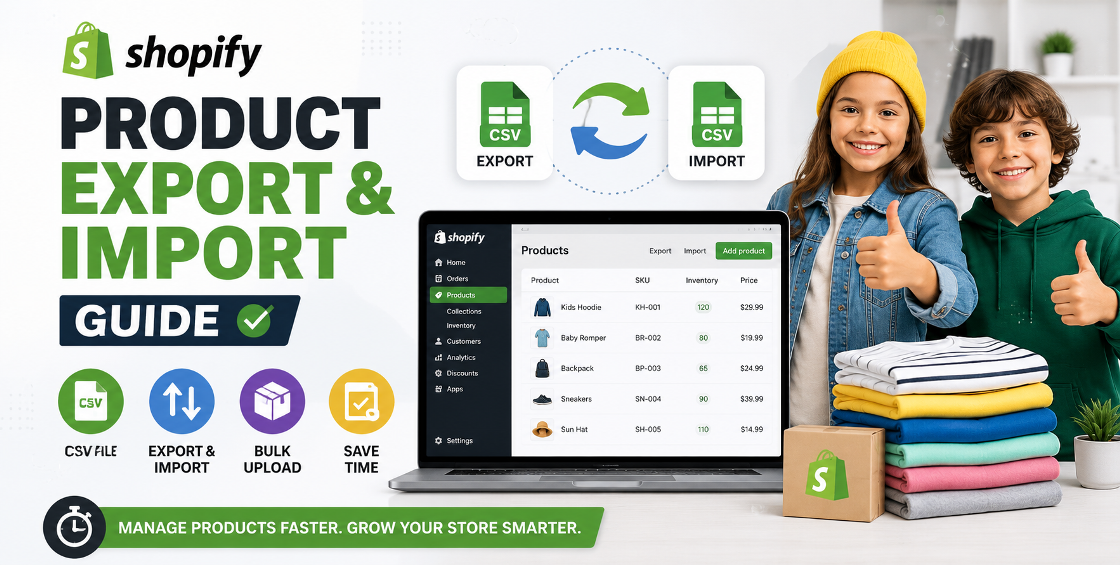
Instead of uploading products individually, complete catalogs were imported using validated CSV files.
Bulk uploads reduced processing time from days to hours.
Once the product structure was reliable, routine updates became much faster.
Price adjustments, inventory changes, new arrivals, and seasonal products could all be processed in batches rather than edited individually.
Although every business is different, the improvements followed a familiar pattern.
The team experienced:
Perhaps the biggest benefit wasn't speed.
It was confidence.
Instead of worrying whether product data was correct, the team could focus on marketing, customer experience, and sales growth.
After working with numerous Shopify catalogs, a few lessons consistently stand out.
Even experienced teams test small batches first.
Uploading thousands of products without validation can create hours of cleanup.
Uniform naming for products, vendors, collections, and variants makes searching, filtering, and reporting much easier later.
Using consistent filenames and organized folders prevents missing product images during imports.
Changing variant structures after products are live often creates unnecessary complications.
Planning options before importing products avoids major restructuring later.
When multiple people manage a store, documented processes keep product uploads consistent and reduce training time.
Many growing businesses unknowingly create extra work through avoidable mistakes.
Some of the most common include:
Fixing these issues early saves countless hours later.
To help visitors continue their journey, consider linking this article to related service pages such as:
These pages naturally complement the topics discussed here and improve overall site navigation.
Growth brings opportunity—but it also brings operational complexity.
What starts as a manageable product catalog can quickly become difficult to maintain through manual processes alone.
The transition from manual product management to automation isn't just about saving time. It's about creating reliable systems that reduce errors, improve consistency, and prepare a Shopify store for long-term growth.
For businesses managing large or expanding catalogs, investing in better workflows often delivers value far beyond faster uploads. It creates a stronger operational foundation that supports future scaling with confidence.




Our Trusted Clients
















Our goal is to help our companies maintain achieve best class positions their respective industries & our team works occur that pleasures have to be repudiated.

Copyright © MyShopifyExpert . All rights reserved.