



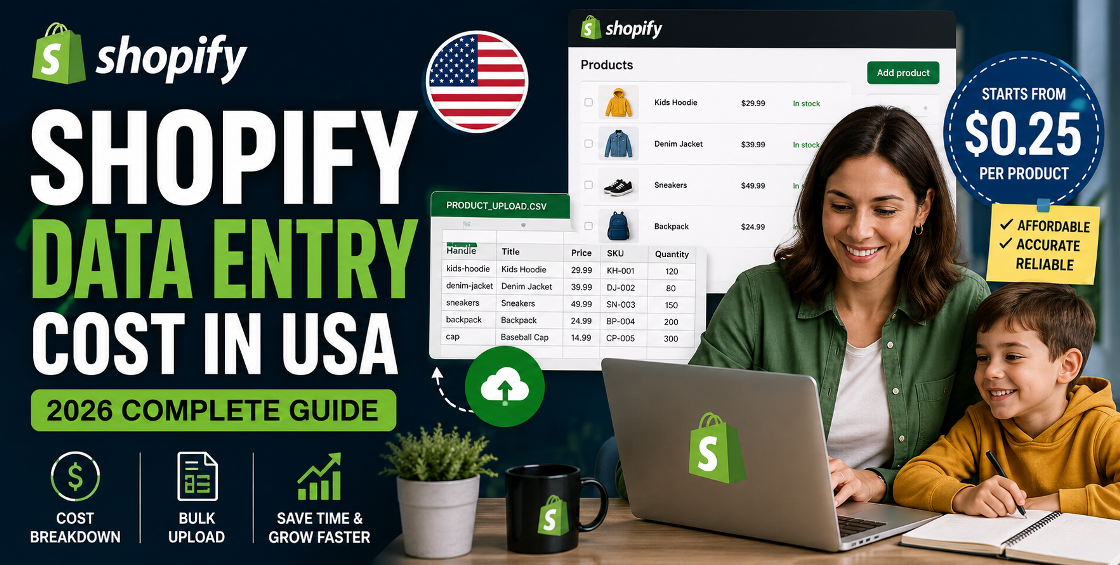
Running a Shopify store looks simple from the outside. Upload products, add images, write descriptions, and start selling.
In reality, product management is often one of the most time-consuming parts of ecommerce.
Many store owners discover this when they try uploading hundreds—or thousands—of products and suddenly run into CSV formatting issues, missing variants, broken collections, duplicate SKUs, image errors, or inconsistent product data.
Whether you're launching a new Shopify store, migrating from another platform, or expanding your catalog, understanding Shopify data entry cost can help you budget correctly and avoid costly mistakes.
In this guide, we'll break down current US pricing, factors that influence costs, and what businesses should look for when hiring Shopify data entry specialists.
Product data is the foundation of your ecommerce store.
Customers see:
Search engines see:
Even small data entry mistakes can create major issues.
We've seen stores lose sales because:
When product catalogs grow into the hundreds or thousands of items, manual management becomes increasingly difficult.
Most Shopify data entry providers charge between:
| Service Level | Typical Rate |
|---|---|
| Entry-Level Freelancer | $8–$20/hour |
| Experienced Shopify Specialist | $20–$50/hour |
| Ecommerce Agency | $40–$100+/hour |
Rates vary based on project complexity and experience.
Basic product uploads typically cost less than advanced catalog management involving variants, bulk imports, SEO optimization, and inventory management.
Many agencies and virtual assistants offer per-product pricing.
Typical ranges include:
| Task | Average Cost |
|---|---|
| Basic Product Upload | $0.25–$1.00 |
| Product Upload with Variants | $1–$3 |
| SEO Product Listing | $2–$8 |
| Complex Catalog Products | $5–$15+ |
A catalog with 2,000 products can therefore range anywhere from a few hundred dollars to several thousand depending on requirements.
The biggest pricing factor is volume.
Uploading 50 products manually requires significantly different effort than importing 10,000 products from multiple suppliers.
Larger projects often qualify for discounted bulk rates.
Variants increase workload considerably.
Examples include:
A single product with 30 variant combinations may take longer than uploading five simple products.
Some businesses provide ready-made content.
Others require:
Content creation increases project cost but can significantly improve search visibility and conversion rates.
Images often require:
This additional work impacts pricing, especially for large catalogs.
Migration projects are usually more complex than standard uploads.
Common migration sources include:
These projects often involve data cleanup, field mapping, and extensive testing before launch.
Many business owners initially manage product uploads themselves.
This works for smaller stores.
However, as catalog size grows, the opportunity cost becomes significant.
Consider a business owner spending:
That's time not spent on:
For many ecommerce brands, outsourcing Shopify data entry becomes more cost-effective than handling everything internally.
After working with Shopify catalogs across multiple industries, several patterns consistently appear.
One of the biggest project delays comes from messy spreadsheets.
Missing:
often require extensive cleanup before import.
A well-structured spreadsheet can reduce project costs significantly.
Shopify's CSV import system is powerful, but small formatting errors can create major issues.
We've encountered situations where:
Proper validation before importing saves hours of correction work later.
Many businesses focus only on getting products live.
A better approach is combining product uploads with SEO optimization.
This includes:
Doing this during upload is usually more efficient than revisiting thousands of products later.
Cheap providers may deliver:
Fixing mistakes often costs more than doing the job correctly the first time.
Many stores upload products without verification.
Always review:
A quality assurance process is essential.
Different naming conventions across products create a confusing customer experience.
Consistency improves:
Inventory mismatches can result in:
Inventory accuracy should always be part of the workflow.
Look for providers who understand:
Ask for examples of previous Shopify projects and request a sample upload before committing to large catalogs.
The right partner should focus on both speed and accuracy.
For most growing ecommerce businesses, the answer is yes.
Professional Shopify data entry services help:
The key is finding experienced specialists who understand how Shopify actually works beyond simple product uploads.
Understanding Shopify data entry cost helps ecommerce businesses plan more effectively and avoid surprises.
While pricing varies depending on catalog size, variants, content requirements, and migration complexity, investing in accurate product management often pays for itself through improved efficiency and fewer operational issues.
Whether you're uploading a few hundred products or managing a massive catalog, treating product data as a strategic asset—not just administrative work—can have a direct impact on store performance and long-term growth.

Our Trusted Clients
















Our goal is to help our companies maintain achieve best class positions their respective industries & our team works occur that pleasures have to be repudiated.

Copyright © MyShopifyExpert . All rights reserved.